

A day in the life of a PhD student researching Barrett’s Oesophagus.
Hi, I’m Lorraine, a third-year PhD student researching electroporation as a novel therapy for Barrett’s Oesophagus. In this blog, I thought I would share an insight as to what a typical day looks like for a PhD student.
Mornings
Usually, I begin my day with checking my to-do list which like most jobs grows and shrinks depending on the time of year. Often my tasks include preparing presentations, data analysis and following up with orders/deliveries I need for my experiments. With that, I check my emails to follow up with company reps and answer any queries. Normally, I will plan my week on the preceding Friday using Google calendar to schedule my experiments, meetings and set reminders so that I stay on top of deadlines. As I work with patient samples, I also consult the schedule for those which Cian, our Barrett’s Biobank manager shares every Friday and plan my experiments accordingly. On Tuesday and Wednesday mornings I attend our departmental and institutional lab meetings, respectively. These are a great opportunity to learn more about what my colleagues are researching as well as the techniques they are using which often stimulates ideas for my own research. Afterwards, we usually go for coffee to discuss, and this is a lovely way to network and connect with the other researchers.
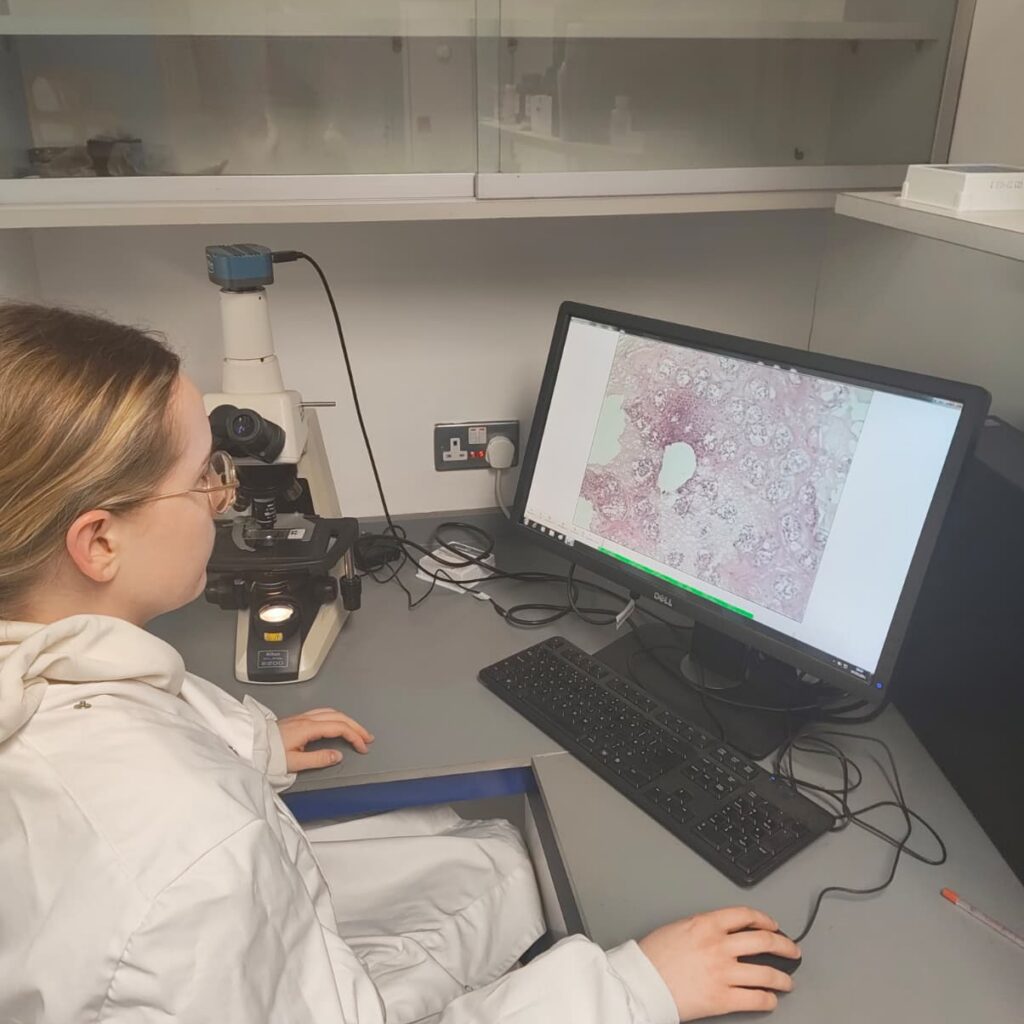
If I have experiments to do, I like to do them in the mornings or as early in the day as possible. The techniques I most commonly do are cell culture, ELISA, flow cytometry and immunohistochemistry. We are particularly interested in how electroporation affects the Barrett’s Oesophagus microenvironment and its effect on immune system activation. I use both cell line models and tissue samples to study this with each model serving as validation for the other.
Afternoons
On some days my experiments will also require a lot of the afternoon. However, typically they comprise of analysing data from my experiments. Here, I frequently ask the other PhD students in my office for their opinions on the presentation of the data and other avenues of analysis to pursue. I am very fortunate to be conducting my PhD in a large department where collaborations are common and there is a vast range of expertise. My supervisor is also fundamental in these decisions. I meet with her regularly where we discuss results, ideas and troubleshoot any issues I may be having. Another key task in the afternoons is updating my lab notebook. This a fundamental part of being a scientist. Often the changes made when optimising an experiment are marginal, but it is key for both myself and others after me to understand how the methodology and results came to pass if anything is being repeated. On Fridays, I receive an email alert for new publications in my field. Some weeks this can be 3-4 papers while other weeks there are 20+ papers. I like to end my end by days by checking these for relevance and making notes of any key points which I hope will be useful when writing my thesis and doing my viva examination. Lastly, I check my emails in case there are any that require my attention and update my to-do list for the following day.
The saying “the best-laid plans of mice and men often go awry” is apt for life in research. No two days are the same, some bring exciting results after starting a new experiment while others (most) are filled with trial and error, but which are important steps in the process to new results. Often, when waiting for patient samples, we don’t receive any due to patients not consenting or more frequently if there is an issue with the procedure. On other days, there may be patients added to the schedule, and we might have to rearrange our day to process additional samples. That unpredictability is what keeps this job exciting. We are incredibly lucky to have access to fresh patient samples, and for me this is a particularly meaningful part of my work. I am motivated in knowing that my work will further our understanding of both Barrett’s Oesophagus and electroporation so that this may help to improve patient outcomes. This makes every day I spend in the lab worthwhile.
Add a Comment